Where Classical meets Cuba: The Sarahbanda come to Manchester
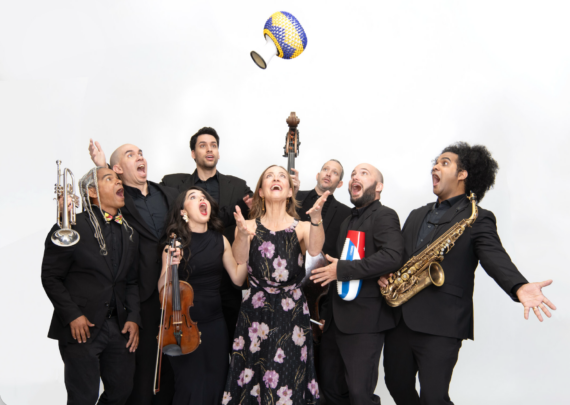
What might Mozart have composed if he’d set foot in Cuba? The Sarahbanda offer a dazzling answer.
Born from a passion for Cuban and classical music, the Sarahbanda reinvent the way classical music can be played, merging the vibrant rhythms of Cuba with the rich sound of the French horn. We asked the band’s founder Sarah Willis about exactly how this innovative vision came to be, and what audiences can expect to hear and dance to at their upcoming show on 12 May.
How did The Sarahbanda get started?
“The Sarahbanda was born as part of the Mozart y Mambo project which I started in 2020 with the Havana Lyceum Orchestra. We recorded all the Mozart horn concertos, added some Cuban rhythms to other famous pieces by Mozart, and played Cuban music as well. The story of how I fell in love with Cuban music is a well-known one and I had always wanted to get closer to the band culture.
“So to play with a Cuban band, I had to make one because French horn is not usually found in any sort of band, let alone a Cuban band. I asked some of Cuba’s finest musicians if they would join me and we had special arrangements made which we included in the Mozart y Mambo orchestral project. When we finished the three albums, we decided we wanted to continue with the band. The name was their idea, not mine, and I love it!
How did you realise Cuban music and the French horn could work together?
“Well, I didn’t! I had no idea but I hoped I could make it work. All I knew is that I loved Cuban music so much and I really wanted to try playing it on the French horn.
“When I had the idea to record the Mozart horn concertos in Havana, I wanted to do things a little differently. We didn’t want to just do all four horn concertos on one album like so many horn players have done before; I wanted to try some Cuban music as well. So, we asked some of the finest arrangers and composers in Cuba today to create new pieces for the French horn and orchestra in a Cuban style. I also had some special guests – a singer, a trumpet player, a saxophone – and we created new arrangements for the French horn like we thought Mozart may have written had he gone to Cuba…
“So no, I didn’t know before if horn and Cuban music would go well together and was very nervous when the first album was released, but people loved it and I’m very, very happy and proud to be playing Cuban music. With this project, we have also created an entire new repertoire for French horn players, I hadn’t found any other Cuban pieces for solo horn before. We have so many new pieces that I hope other horn players will want to play and fall in love with Cuban music like I did for generations to come. It makes me happy when horn players send me videos of them playing our music.”
What unique qualities does the horn bring to Cuban dance music?
“Cuban dance music is very rhythmical, and the horn must play in time, otherwise you get left behind. The qualities I can bring sadly do not include improvisation – I do my best, but I will never be as good an improviser as the Cubans! I try and bring a lyrical quality with my horn. The horn is good for slow music like boleros and cha-cha-chas with beautiful melodies. Faster pieces are harder because of the way we play – the horn points backwards, which makes the sound much less direct and harder to hear in dance music.
“I’ve had to find a different technique to be able to play Cuban dance music in the way that it needs it – like a harder attack than I would use in classical music and pointing my bell partly towards the audience. The unique qualities I can bring are the sound of the horn and the mixture of sounds that we make in the Sarahbanda, like with the horn and the saxophone or the horn and the trumpet. And as far as I know, we are the only Cuban band who plays with classical music phrasing and dynamics!
It is a give and take. I brought my classical music knowledge to the band, and they have taught me so much about Cuban music. It’s very much a learning experience for everyone and a constant exchange. We love it!”
How do you balance staying true to Cuban styles while bringing in your own classical background?
“It was very important to me to learn as much as I could about Cuban music to tackle this repertoire. I don’t just play along and hope for the best. I have learned all about the history of many Cuban dances and Cuban rhythms: the bolero, the cha-cha-chá, the guaguancó, the Afro Cuban rumba, the son, the timba, all these rhythms and all the traditional ones like the danzón and the changüí. I’ve sat down and really learned – well I’ve actually stood up and learned because the Cubans say if you can’t dance it, you can’t play it! Once you have them in your body they’re a lot easier to play. I had to be very serious about learning it so that I could sound very light-hearted when I played it.
What do you hope audiences will experience at your Sarahbanda concert?
“I hope they leave the hall with a huge smile on their face and rhythm in their hips and are curious to find out more about Cuban music, about Mozart y Mambo and about the Sarahbanda and these wonderful musicians I am so happy to be playing with. It’s very important to us to connect to our audiences and we hope to have everyone on their feet at the end of the concert – we have never finished a Sarahbanda concert where not everyone has been up and dancing. It doesn’t matter if you think you can’t dance, Cuban music gets under your skin and makes you twitch, dance, whirl and jump. (But please, non-dancers amongst you, don’t let that scare you off!)
“I challenge anyone to stay sitting in their seats at the end of our concerts. We hope everyone will have a good time and will love our mixture of classical and Cuban styles. After the concert we will go out into the foyer for a jam session and connect with the audience – this is an important part of our concerts and we’re really looking forward to meeting everyone.
“The other thing I’m looking forward to is introducing my band to Manchester because it’s the first time there. They were asking me, “what should we do in Manchester, can we go and watch Manchester United?” And I said only if you try the local food first! They asked, “what is the local food?” I knew about Eccles cakes and black pudding, and I’d heard about parched peas and Manchester tarts, and something called pasty barms from my Granny, who came from Bolton. I’m going to make them try it all!”
“We’re very grateful to Tom Redmond and Chetham’s School of Music for making this special concert possible – our UK debut – and we can’t wait to see you all in Manchester!”
The Sarahbanda bring their electrifying fusion of classical music and Cuban rhythms to Stoller Hall on 12 May at 7:30pm. Get tickets now on our What’s On page.